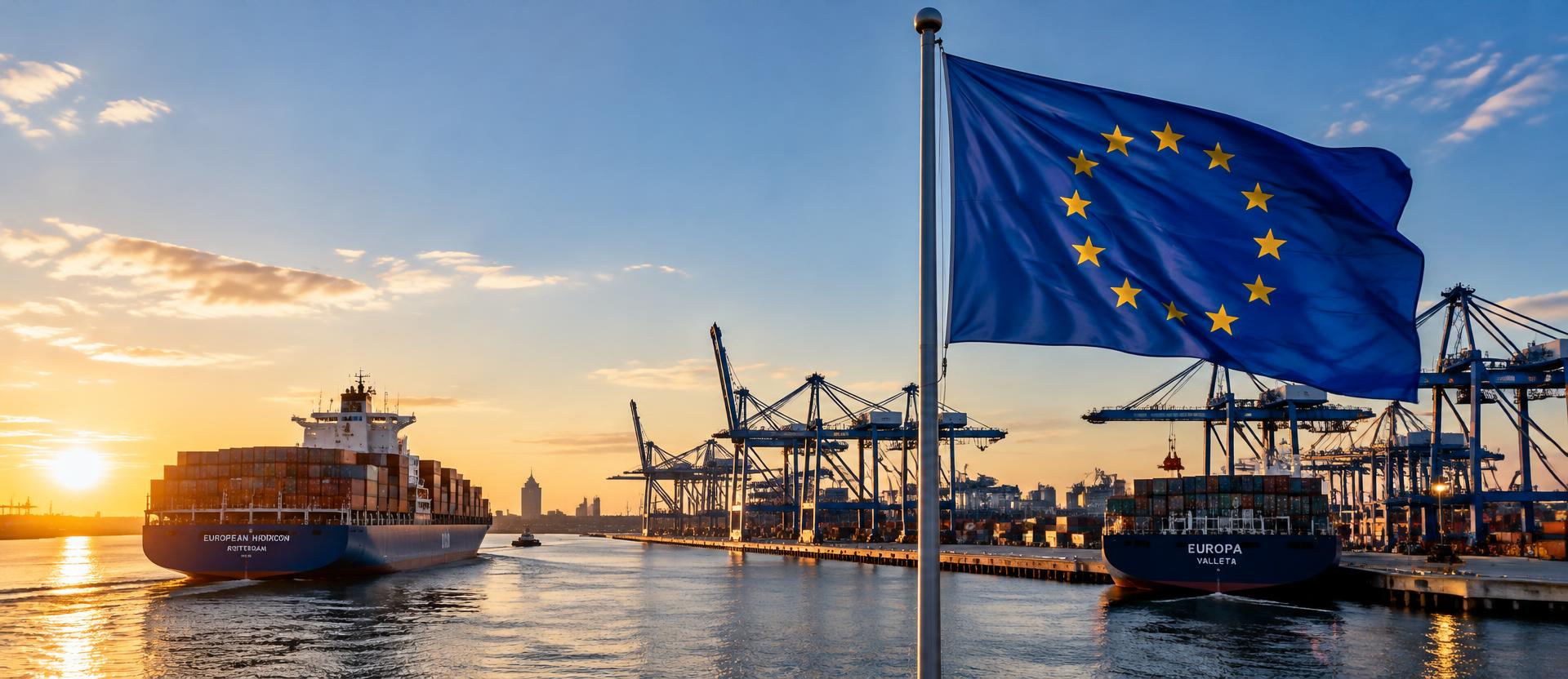
How the EU backs Europe's maritime future
Funding
Billions of euros flow through EU funds into ships, ports, training and research every year.
Common rules
One set of maritime rules across 27 countries makes certificates, wages and safety standards portable.
Free movement
As an EU citizen you can work in any member state's maritime sector — no permit needed.

One union, one sea, millions of maritime jobs
Europe's blue economy employs over 3.5 million people — shipbuilders, port workers, offshore technicians, fishermen, engineers and sailors. The European Union is the engine behind it: it funds the transition to clean shipping, keeps the seas safe and open, and guarantees that your diploma, certificate and work experience count in every member state.
Programmes that pay for maritime
European Maritime, Fisheries and Aquaculture Fund (EMFAF)
The EU's main fund for the blue economy: it co-finances modern fishing fleets, sustainable aquaculture, coastal communities and maritime skills training across all member states.
What it means for you: Funded training and retraining programmes that help workers move into maritime roles.
Official EU source →Horizon Europe
The EU research programme funds breakthrough maritime technology: zero-emission ships, autonomous vessels, hydrogen and ammonia engines, smart ports and ocean observation.
What it means for you: Every funded project creates demand for engineers, technicians, data specialists and crew.
Official EU source →Connecting Europe Facility (CEF)
Finances the TEN-T transport network — including Europe's core ports, inland waterways and short-sea shipping corridors that connect member states.
What it means for you: Modernised ports mean continuous investment in port workers, equipment and maintenance jobs.
Official EU source →Erasmus+
The EU's education programme pays for study exchanges, apprenticeships and vocational training — including maritime academies and shipyard placements abroad.
What it means for you: Free or funded pathways for young Europeans to start a maritime career in another country.
Official EU source →Innovation Fund & Just Transition
Large-scale funding for clean technology demonstration — including green shipping corridors, alternative fuels and decarbonising heavy industry in port regions.
What it means for you: The green transition is creating entirely new roles: bunkering crews for alternative fuels, battery technicians, retrofit welders.
Official EU source →Rules that create and protect maritime jobs
FuelEU Maritime
Requires ships calling at EU ports to cut their greenhouse gas intensity step by step — pushing shipowners to hire people who can operate and maintain cleaner vessels.
EU Emissions Trading System for shipping
Since 2024 shipping pays for its CO₂ emissions in the EU ETS, making energy-efficient operations and green skills a hiring priority.
Alternative Fuels Infrastructure Regulation (AFIR)
Obliges core EU ports to install shore power and refuelling for cleaner ships — an EU-wide building programme with jobs in electrical work and installations.
Mutual recognition of certificates (STCW)
Seafarer certificates from EU/EEA countries are recognised across the union, so a Polish officer can sail on a Cypriot vessel for a Greek owner.
Free movement of workers
EU/EEA citizens can live and work in any member state without a work permit — the foundation this whole platform builds on.
European Maritime Security Strategy
Coordinated coast guard cooperation, safer waters and growing demand for surveillance, security and port-facility roles.
Who does what in Brussels and beyond
DG MARE
The European Commission department for maritime affairs and fisheries — designs the EU's blue economy policy.
EMSA
The European Maritime Safety Agency — keeps EU waters safe, trains inspectors and supports member states' coast guards.
European Maritime Day
The annual EU celebration of the maritime sector every 20 May — conferences, open days and school events in port cities.
EU Blue Economy Observatory
Official data on the 3.5+ million people employed in Europe's blue economy — from shipbuilding to coastal tourism.
Supported by the EU and its 27 member states


Your maritime career, backed by Europe
Train with EU money
EMFAF and Erasmus+ co-fund maritime courses, from welding certificates to officer training — ask your national training institute what is subsidised.
Work across borders
Your certificates travel with you. A Ukrainian-born EU citizen can start in a Polish shipyard and move to a Dutch yard without new permits.
Ride the green wave
EU decarbonisation rules are creating a hiring boom: alternative-fuel engineers, shore-power electricians, retrofit specialists, emissions analysts.
Start near the ports
CEF-funded port upgrades keep building across all member states — from Gdańsk to Valencia to Constanta.
Official EU sources
Everything on this page is summarised from the European Union's own publications.
Ready to use what Europe offers?
Browse maritime vacancies in every EU country, or match your existing skills to a career at sea or on shore.
Maritime Jobs EU is an independent European project supported by the framework of EU programmes for the maritime sector. Programme details on this page are summarised from official European Union sources; always check the linked official pages for current funding conditions. The European flag and the member-state flags are used to indicate European cooperation.